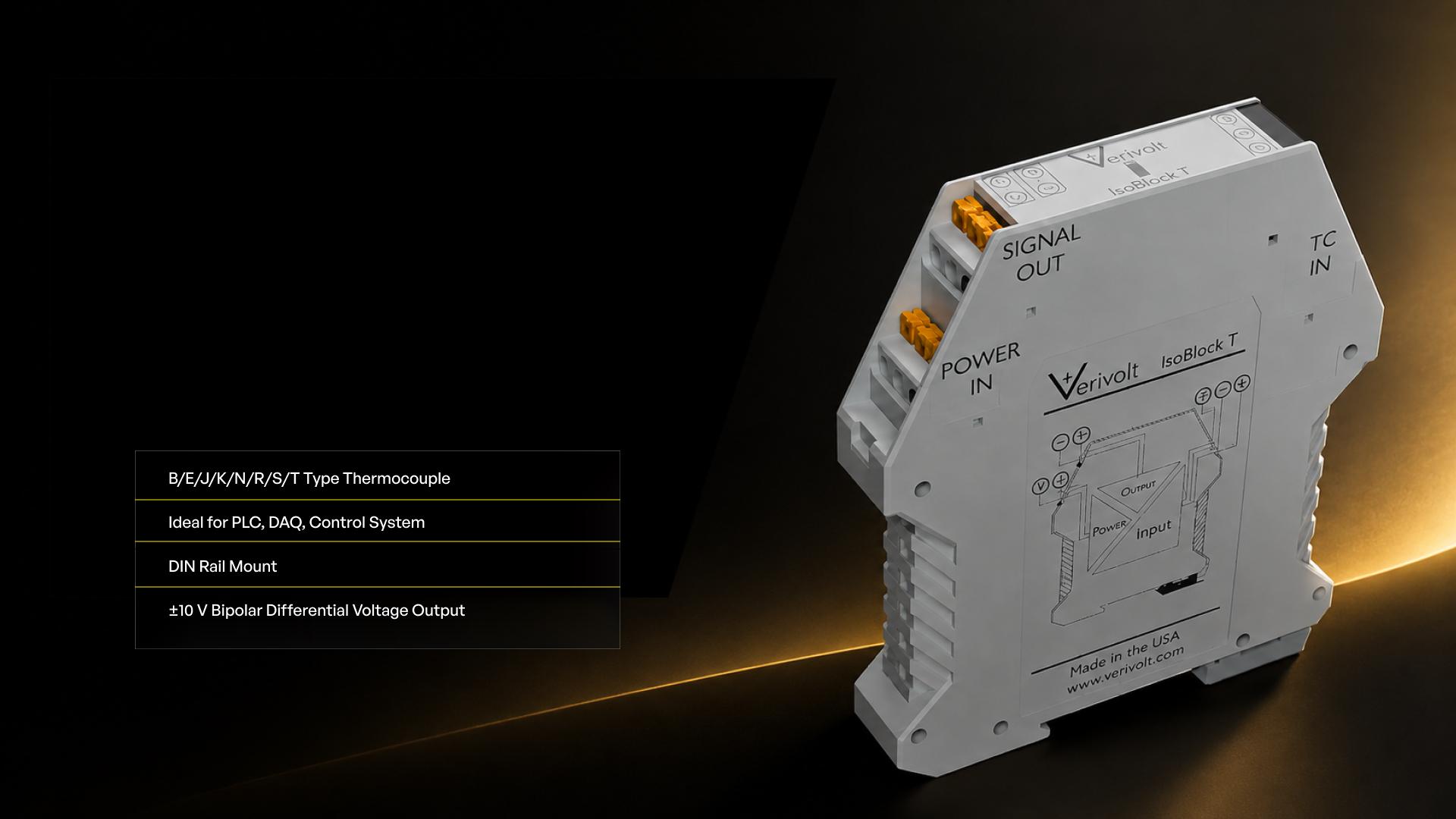
Verivolt Product Note
Important Note: Verivolt Voltage and Current Notation
To avoid any confusion when reviewing Verivolt product configurations, specifications, and output ranges, Verivolt uses specific notation for peak and RMS values.
This note explains how Verivolt uses V, VAC, A, and AAC across voltage and current sensing products.
Voltage Notation: V vs. VAC
We use “V” to denote peak voltage values, and “VAC” to denote RMS voltage values. The RMS-to-peak conversion factor is √2, approximately 1.42 (Vpeak = Vrms × √2 ≈ Vrms × 1.42)
For example, if a sensor specifies an input and output range of 100 VAC to 7 VAC, this means:
- It accepts an input of 100 Vrms, which equals approximately 142 Vpeak
- It outputs 7 Vrms, which equals approximately 10 Vpeak.
Conversion Reference
Vpeak = Vrms × √2
√2 is approximately 1.42, so RMS values can be converted to peak values by multiplying by approximately 1.42.
Current Notation: A vs. AAC
For current sensors such as the IsoBlock I-ZF, Verivolt also distinguishes between RMS and peak current notation.
RMS vs. Peak Notation (AAC vs. A): We use AAC to indicate RMS current and A for peak current. This helps users avoid manual conversions. For example, 100A corresponds to 100 A peak input, while 100AAC corresponds to100 A RMS input ≈ 142 A peak.
An IsoBlock I-ZF (100AAC, 7VAC) has a 142 A peak current range and a 9.94 V peak output.
Quick Reference
| Notation | Meaning | Example |
|---|---|---|
| V | Peak voltage value | 10 Vpeak |
| VAC | RMS voltage value | 7 VAC ≈ 10 Vpeak |
| A | Peak current value | 100 A peak input |
| AAC | RMS current value | 100AAC ≈ 142 A peak |
Why This Matters
These notation standards are intended to make product selection clearer and help users interpret input and output ranges consistently across Verivolt voltage and current sensing products.
Verivolt Product Note
Important Note: Verivolt Voltage and Current Notation
To avoid any confusion when reviewing Verivolt product configurations, specifications, and output ranges, Verivolt uses specific notation for peak and RMS values.
This note explains how Verivolt uses V, VAC, A, and AAC across voltage and current sensing products.
Voltage Notation: V vs. VAC
We use “V” to denote peak voltage values, and “VAC” to denote RMS voltage values. The RMS-to-peak conversion factor is √2, approximately 1.42 (Vpeak = Vrms × √2 ≈ Vrms × 1.42)
For example, if a sensor specifies an input and output range of 100 VAC to 7 VAC, this means:
- It accepts an input of 100 Vrms, which equals approximately 142 Vpeak
- It outputs 7 Vrms, which equals approximately 10 Vpeak.
Conversion Reference
Vpeak = Vrms × √2
√2 is approximately 1.42, so RMS values can be converted to peak values by multiplying by approximately 1.42.
Current Notation: A vs. AAC
For current sensors such as the IsoBlock I-ZF, Verivolt also distinguishes between RMS and peak current notation.
RMS vs. Peak Notation (AAC vs. A): We use AAC to indicate RMS current and A for peak current. This helps users avoid manual conversions. For example, 100A corresponds to 100 A peak input, while 100AAC corresponds to100 A RMS input ≈ 142 A peak.
An IsoBlock I-ZF (100AAC, 7VAC) has a 142 A peak current range and a 9.94 V peak output.
Quick Reference
| Notation | Meaning | Example |
|---|---|---|
| V | Peak voltage value | 10 Vpeak |
| VAC | RMS voltage value | 7 VAC ≈ 10 Vpeak |
| A | Peak current value | 100 A peak input |
| AAC | RMS current value | 100AAC ≈ 142 A peak |
Why This Matters
These notation standards are intended to make product selection clearer and help users interpret input and output ranges consistently across Verivolt voltage and current sensing products.